Leigh Wilson and Rob Inman of Boise's Best Real Estate Prove Smaller Teams Win
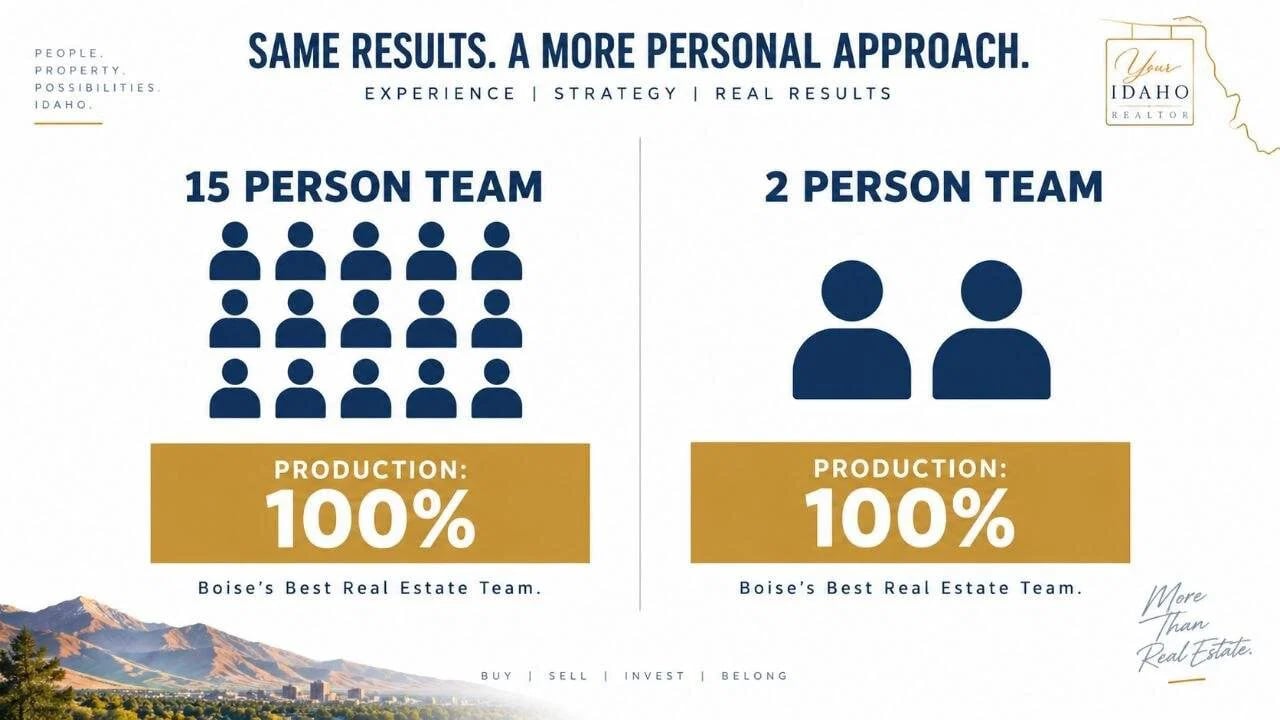
Most agents think growing a real estate business means hiring more people. Leigh Wilson and Rob Inman of Boise's Best Real Estate proved the opposite. They built their team to fifteen people, then deliberately cut it back down to two, and their production never dropped.
I sat down with Leigh and her son Rob on a recent episode of Your Idaho Realtor to talk about how a smaller team can outwork a bigger one, and what that means for anyone buying or selling in the Treasure Valley.
Curious about this conversation? Here's a preview of our discussion. Check out the YouTube Shorts clip below.
I opened the conversation by asking Leigh and Rob what the phrase "building foundations" actually means to them, not just in business but in life. Rob answered first. To him, it means building something sustainable with rules you never bend. Leigh's version is simpler. She leaves everything a little better than she found it. I've written before about what building foundations really means in real estate, and this conversation added a whole new layer to that idea.
Leigh has been in real estate for two decades. She built Boise's Best Real Estate Team from a solo practice into a full 15-person operation, complete with a 14-year business partnership that eventually ended. Then she rebuilt it again, this time on purpose, into a team of exactly two: herself and her son, Rob Inman.
Rob spent nine years in the Air Force managing a shop of 42 people before he joined the team as Director of Operations. The two of them do the same production now that fifteen people used to do. No buyer's agents to manage. No underperformers to fire. Leigh put it plainly: technology changed what a team even looks like. Virtual assistants and remote coaches mean two people on the ground can run circles around a much bigger roster, if the systems behind them are tight enough. You can see how that plays out day to day by checking out the team's page on Facebook.
Watch the full video here:
Every referral this team makes gets vetted the same way, and it has nothing to do with a slick pitch deck. Before any contractor, lender, or title company touches a client's home, they have to work on Leigh's or Rob's own house first. It's part of a broader philosophy about knowing what to look for in the people you trust with a transaction, whether that's an agent, a vendor, or anyone else in the process.
"We tell our vendors when they call me and they say, 'How do I get on your vendor list?' I say, 'Well, the first thing you have to do is you have to either work on my house or Rob's house. You're not stepping into one of my clients houses until you've done work for me.' Well, if you're going to mess something up, you're going to do it on my house or you're going to prove yourself on my house before you ever go out there. Because we all know that whether it's a contractor, a title company, an escrow officer, a lender, whoever it is, if they screw up somewhere along the road, it comes back as a reflection on us. I basically get their bids, get their stuff, get whatever we need, get the project dialed in, and then I'm the one that's overseeing that contractor. That way, when there's a problem, I'm the one that has to hold that contractor accountable."
Leigh and Rob run what amounts to a full concierge department inside a two-person shop. They check every bill against every bid. They coordinate movers, U-Haul reservations, cleaners, and contractors so out-of-state buyers land in Idaho to find things already handled. One recent client was an 80-year-old man downsizing out of a home he had lived in for 45 years.
Rob stepped in to handle the logistics so the man could focus on the emotional weight of the move rather than the paperwork. If you're on the other side of that process and thinking about listing a home in the Treasure Valley, this is the level of hands-on coordination that separates a good agent from a great one.
Leigh once had her CRM client database dialed in so precisely it ran on near autopilot, sending roughly 30 templated emails a day to buyers and sellers without her lifting a finger. Then she switched brokerages, and the system she had spent years building disappeared with it. You can see how far the rebuilt version of that database has come by following the team's day-to-day work on Instagram.
"I dialed that thing in. I had it on autopilot. It was sending out templates of emails to buyers or sellers. I mean, I was sending out probably 30 emails a day. Didn't even know I was, and I switched brokerages. And in that transition, we lost Sierra. I'm still climbing out of that hole from switching brokerages and switching CRM. I just felt defeated when I lost everything. I lost all of the notes that I had with clients. And you know how CRM leads come in, and usually they're warm leads, but they're looking maybe two years before they move. So you get that first contact and touch and form of communication, building that relationship years before they actually make that out-of-state move. I was following up with so many of them. I was getting close to that second year mark. I had their names, but there was- I can't remember which one- what was their name- and someone just had knee surgery, and I had been following up with her on that, and it's like, what do you do? It was a big loss for me."
That kind of loss is why real estate CRMs have become such a critical part of agent operations across the industry, not just for automation but for preserving the relationship history behind every warm lead.
Rob can unravel a CRM sales pitch in about ten minutes flat now, simply by asking a salesperson what the software actually does. Most of the time the answer collapses under a few pointed questions. He and Leigh have owned the cheapest CRM on the market and the most expensive one, and neither price point guaranteed results on its own.
Their advice for any agent shopping for new tools: decide exactly what you need the technology to do before you ever sit through a sales demo. Too many agents get sold at industry conferences on tools that sound revolutionary and turn out to be useless six months later.
According to the National Association of Realtors, teams that operate with strong internal systems report substantially higher transaction sides than individual agents working without one, which tracks with exactly what Leigh and Rob have built.
Leigh coaches a method she calls the done by one method, and it is one of the most requested lessons from her clients years after they first learn it. It grew out of the same instinct behind breaking the reaction mode cycle that so many entrepreneurs get stuck in, where the day runs you instead of the other way around.
"I coach; it's called done by one. And basically all of your big rocks, all your income-producing things or your big projects, those are done by one. Because we know that if our day is going to blow up, it typically will blow up in the afternoon. That way, when your afternoon blows up, that's okay because anything that's going to move your business or your life forward has already been done. So it doesn't matter what happens in the afternoon. Gary Keller was famous for always saying get everything done by noon, and then I don't care what you do the rest of the day. Go golf, go play with your dog, I don't care, do the big rocks in the morning. And I will tell you that the people that I coach, when I go back to them later, and I say, 'What's the number one thing that you got out of this?' It's always done by one."
Leigh gives credit for the concept to author Brendan Burchard, and she pairs it with an old military habit Rob brought home from the Air Force: making your bed every morning, not for tidiness, but because it is the first proof of the day that you accomplished something. It's a small ritual, but it works the same way as having an actual plan of action for anything else in life. Nothing moves forward without one.
Leigh describes herself as a DC personality on the DISC behavioral assessment, a profile defined by high drive and heavy task orientation. It is one of the least common combinations, and it comes with a real cost if left unchecked.
For years, her instinct was to do everything herself, working twenty-hour days and refusing to hand anything off. Her biggest lesson came down to letting go of roughly twenty percent of that workload and trusting someone else with it. That single shift is what finally gave her something resembling a normal schedule.
Rob's version of the same lesson came out of the military just as directly. He was trained to focus purely on efficiency, with little room for how a decision might land emotionally. Coming home, he had to relearn how to meet people where they are, a shift that reshaped how he handles the moving parts of every transaction, from spooked buyers to grieving sellers. You can trace how that team dynamic works day to day by seeing how that partnership runs in practice.
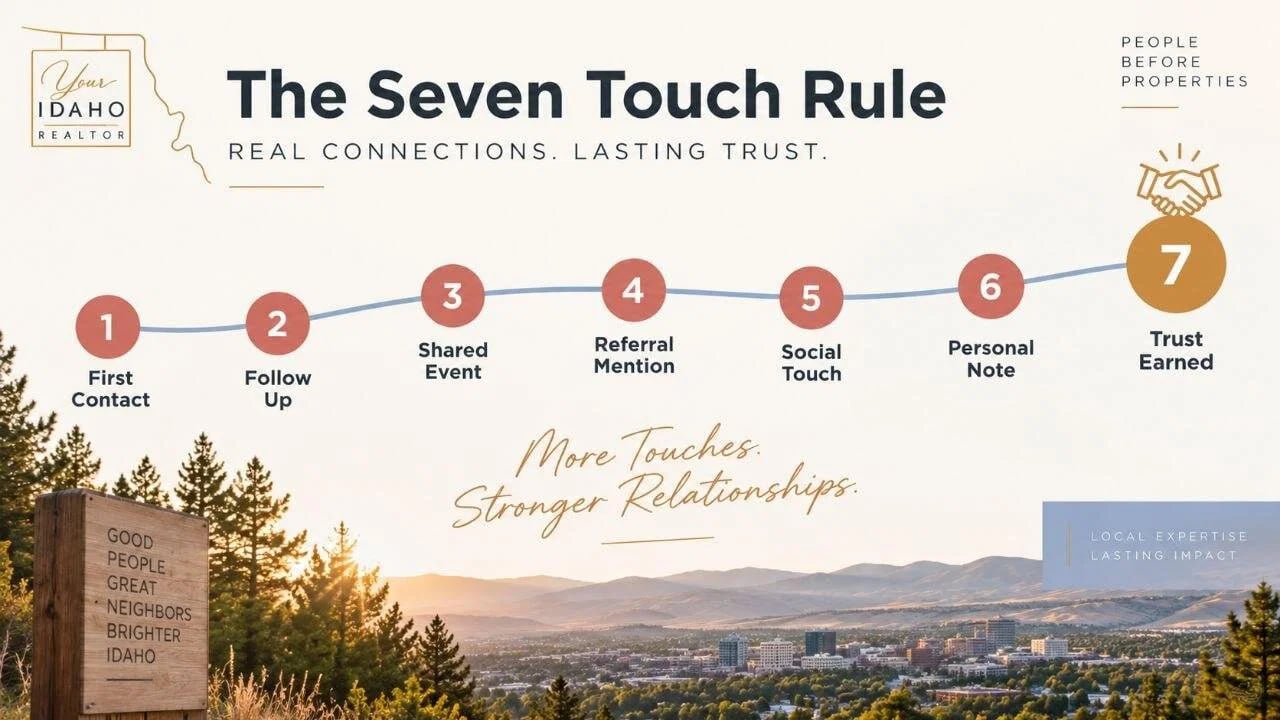
Leigh explained the seven touch rule using an unexpected example: a parent trying to arrange a playdate. Even something as low stakes as connecting two families for their kids takes roughly five to seven points of contact before real trust forms. A realtor building a relationship with a new client works on the exact same math.
At least a few of those seven touches need to be organic, not scripted. Sharing a church group, a kid's sports team, or a neighborhood event does more for trust than a cold outreach ever will. According to marketing research often summarized as the rule of seven, prospects typically need multiple points of contact before they act, and real estate relationships follow that same pattern closely.
That principle matters more, not less, as automation takes over more of the industry. There's a real argument to be made about why human relationships still outperform automation in small, service-based businesses, and real estate is one of the clearest examples of it. If someone doesn't trust you as a person first, Leigh said, they will never trust you as a realtor, and they certainly won't trust you with their kids.
Leigh raised Rob as a single mother while working roughly 100 hours a week, but she structured every one of those hours so they never once got in the way of a school conference, a basketball game, or a track meet. She now vacations 15 weeks a year, including a recent trip to Antarctica, while Rob still handles operations from wherever he happens to be in the world.
The two of them also talked candidly about what happens when a job becomes a hobby instead of staying a job. Leigh's rule is simple: if you can't answer the question "what do you do outside of work," something needs to change. She has watched too many agents chase the average Treasure Valley real estate income of about 1.2 homes sold per year, a figure that reflects just how top-heavy this industry really is, with a small percentage of agents doing the overwhelming majority of the business. Some of that comes down to constantly building a business around who you are now instead of who you used to be, rather than clinging to a version of your business that no longer fits your life.
Rob's own transition out of the military carries a broader lesson too. The discipline and adaptability he built over nine years in the Air Force translated directly into how he manages operations for Leigh Wilson and Rob Inman of Boise's Best Real Estate, and it's a reminder that the best real estate operators often come from backgrounds that have nothing to do with real estate at all. If any of this resonates with your own move to or around Idaho, you can keep the conversation going anytime.
Want to hear my full conversation with Leigh Wilson and Rob Inman of Boise's Best Real Estate about how a two-person team can outproduce fifteen? We dive deep into the vendor rule that protects every client, rebuilding after a CRM disaster, and the "done by one" method that keeps their business on track. Listen to the full episode now!
Leigh founded the team in 2005 and grew it to fifteen people before scaling it back to just herself and Rob, using systems that don't depend on headcount to keep production steady across the Treasure Valley.
It's a time management approach where agents finish their income-producing tasks before noon, so nothing urgent that surfaces later in the day can derail the business.
Because any vendor's mistake reflects on the referring agent, the team requires every contractor to prove their work on a team member's own property before that vendor ever touches a client's home.
I work with buyers and sellers across the Treasure Valley and can be reached directly through my website.
The Treasure Valley is full of people doing the real work behind every closing, every fix, and every hard conversation with a client. If you're actively serving buyers and sellers in Idaho and have hard-earned lessons worth sharing, I want to hear from you.
Stay up to date on the latest real estate trends.
A two-person Boise real estate team proves smaller teams can outperform.
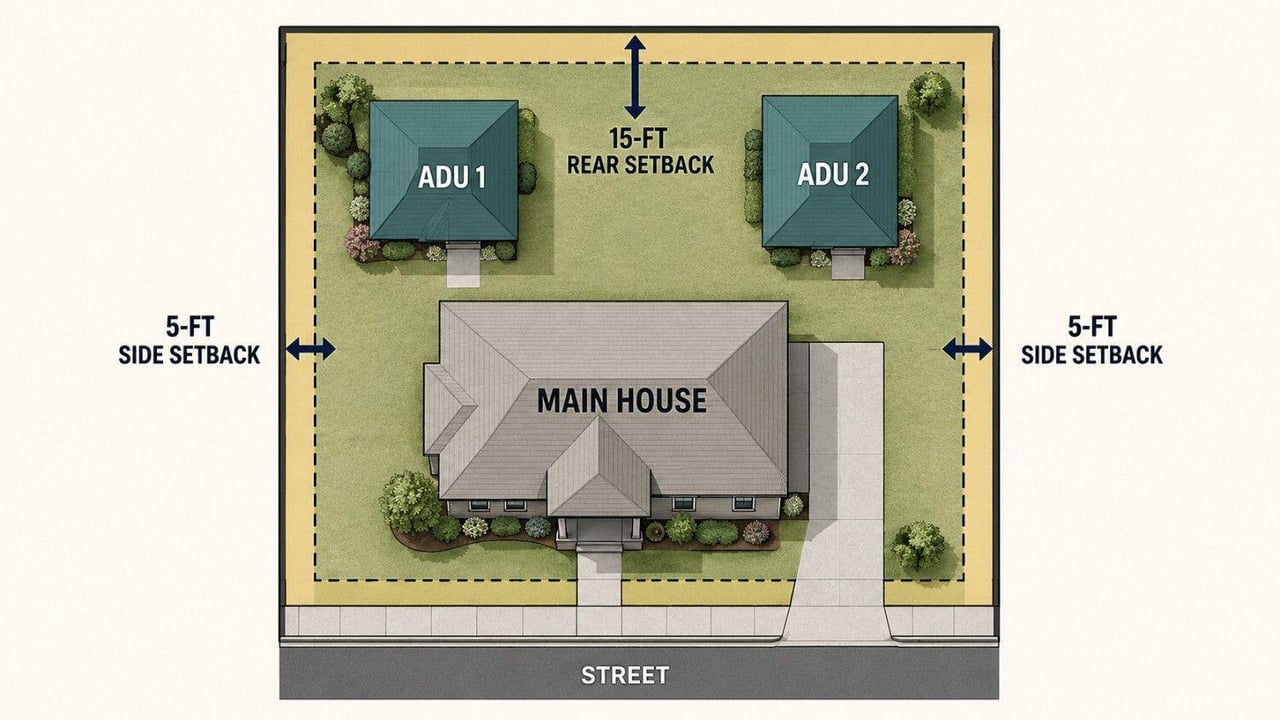
Unlock hidden value in Boise real estate through infill development and ADUs with expert insights from Zach Matson.

Join Bently Perry as she explores the importance of self-reliance and confidence in the homeownership journey.

Explore the human side of real estate, finance, and community with Dertrez Pressley in this new podcast series.
Explore how infill development and new ADU ordinances are creating massive opportunities for real estate investors in the Treasure Valley.

Ever wonder where your mortgage money actually comes from? Discover the cycle of mortgage banking and how institutions fund your home loan.

Understanding the health risks and disclosure requirements of lead-based paint in older homes.

A strategic guide to navigating the home selling process, from understanding your motives to closing the deal with confidence.

Are biweekly mortgage programs worth the fees? Discover how to achieve the same savings on your own for free.
From your first conversation to the closing table, our team is committed to providing knowledgeable guidance, transparent communication, and an experience built around you.